Client: Swiss Museum of Transport, Luzern
Task: Development of an interactive exhibit
Role: Concept/Interaction Design/UX/3D Modeling
Energy is the bedrock of modern society. It brings light to the dark, powers machinery, and keeps our digital world running. But how does electricity reach the places where we need it? And what lies behind the interplay of supply, storage, and consumption?
To provide tangible answers to these questions, three interactive installations were developed for the Swiss Museum of Transport. These exhibits translate complex energy topics into playful, intuitive experiences:
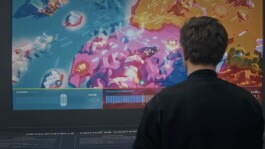
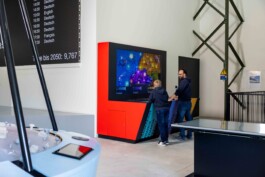
Netzleitstelle (Grid Control Center): Demonstrates how the European power grid operates and why maintaining a balanced frequency is so critical.
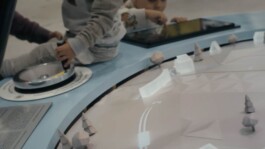
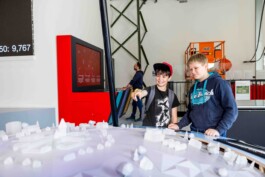
Tiny Planet: Illustrates the flow of energy through a city like Lucerne. Visitors can interact with an abstract city model to discover how energy moves through everyday life.
In collaboration with a team specializing in design, scenography, and game development, an immersive experience was created that conveys knowledge both emotionally and through play. The exhibition not only clarifies how today’s energy systems function but also offers a glimpse into a more sustainable future. As global energy demand grows, topics such as efficiency, storage technologies, and the integration of renewable energy sources are becoming increasingly vital.


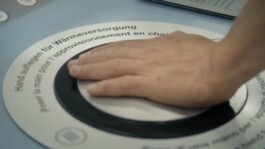
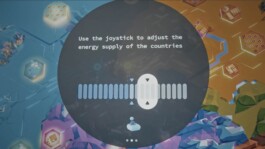
One focus in the design and development of the interaction principles lay in simple handling for a diverse number of different target groups (from 6–99 years, as it were), so that various interfaces and their basic principles were reconceived, modified, and sketched out. Thus, one finds interfaces like left-right joysticks and miniature bus steering wheels for the translation of controlling certain values along linear ranges/faders. On the other hand, analogies of the toggle and on/off principle can be found in the form of physical buttons, foot pedals, and placement mechanisms using temperature difference measurement. In this way, a complex system can be controlled playfully through analog-proven and cognitively internalized movements, even without becoming aware of existing game rules—free to the motto 'learning by doing,' or: sustainable knowledge and interest are established through playful and joyful engagement.